Showing posts with label art. Show all posts

Sunday, August 16, 2015

Shopping in the Federal District of Mexico: Ciudadela and Sonora

In the afternoon while still in an interesting session, C messaged me and told me he and R are going shopping. They asked if I would like to go with them. I'm not a big fan of shopping but knowing these two are culture buffs, I know I am in for a good shopping experience.

Before meeting them, I went to the washroom and found two friendly Mexican women who are friendly and lovable. When they asked me what session I would be attending next, I replied that I would be going out shopping with the two boys. They asked where and when I said "Sonora" they were shocked and told me not to go because it's a dangerous place. As an alternative, they recommended Ciudadela to me. They were even shocked to know that R was looking for a certain image of Santa Muerte for his friend. They cautioned me against this.

on the way to Ciudadela by foot, we saw this library

So anyway, we did as they said, visiting Ciudadela instead. The market does not disappoint. It was very near a subway station so getting there was no trouble at all. I love the place ENTIRELY! It reeks of CULTURE: crafts and art abound and what really excited me was that not a few stalls are selling MUSICAL INSTRUMENTS!!! (If only I had the moolah but then I was thinking about my budget for the remainder of my stay...)

a colorful resto in Ciudadela
 Except I wasn't able to take lots of photos inside because my eyes got busy feasting on all the wonderful crafts and my mind was thinking of ways to earn more money and when I would be able to come back to Mexico, and which musical instruments to buy, if I would have enough time to learn another instrument (they have a wide range of instruments under the guitar family and I would also love to get my hands on Mexican violins... SIGH!), and countless other things. Oh the things you think for LOVE and PASSION...

my favorite tacos, couldn't get enough of this!
 Not finding the specific image of Santa Muerte, we decided to brave the Sonora Market. The place is pretty much Divisoria so we didn't have difficulty in adjusting. Same tips: be alert and be vigilant. C and R even reprimanded me when I took out my cam to take a photo of the market. The only single photo I have of the place... #jujubels. But anyway, better safe than sorry!

Sonora market
When we got back to the conference, I met up with the Mexican women again and told them our adventures. The look on their faces when we told them we went to Sonora despite their warnings! But I deeply am thankful for their concern and for the relief I saw upon learning that nothing bad happened to us. They are so motherly!!! (I miss them already and we only get to communicate these via Facebook only...)

What we did early in the morning:

Wednesday, November 19, 2014

Jeju Stone Park Museum

To get to Jeju Stone Park Museum, one has to walk through mini forested area where I enjoyed the fresh air and again being with nature.

Inside the museum are scientific discoveries mainly bordering on the geology of the island. Such a museum, with a huge collection of different rock types, is where I can definitely spend an entire day in, being a lover of lithics. Of particular interest is the suiseki, natural rock formations which can be viewed and admired in an aesthetic way. This art was originated in Japan and is again, one aspect which Koreans borrowed.

volcanic rocks of different sizes and forms inside the musem
Because Jeju is a volcanic island, its inhabitants made use of the rocks to fashion stone crafts and implements for use in farming, fishing, stock raising, construction of fortresses, and transportation. Indeed the stone culture is very much prevalent in this part of South Korea, that even stone objects are worshiped by the people as guardians. 

Interplayed with the natural surroundings which has been wonderfully preserved despite the construction of a museum in 2001 is the mythology that tells the beginning of Jeju Island. It tells of how Grandmother Seolmundae created Jeju Island. In fact, many myths portray old women as primary divine beings, which reflect the matriarchal culture where women toil hard and men just relax.

500 Generals expressing love for their mother who sacrificed herself for them, Mt. Halla in the background

Grandma Seolmundae and the 500 Generals lithic monuments

Teddy Bear Museum, Jeju Island, Korea

I will have to say that Korea has borrowed a lot from the Japanese despite the Koreans' hatred towards the Japanese because of what happened during World War 2. Of the Japanese war crimes, perhaps the most famous is the Rape of Nanking and in the Philippines, well known among history aficionados is the Rape of Manila. This borrowing, I suppose, is not out of admiration but due to desire for revenge. At present, Korean telenovelas have replaced J-dramas, K-POP pushed J-POP to the sidelines, and Korean makeup is gaining raves even from Westerners. In short, it is a popular cultural battle, out to defeat Japan.


One of these borrowings is the preference for all things cute and cuddly especially among teenagers. Our group has more young once than young ones but that didn't deter the guide from taking us to Teddy Bear Museum. Upon entering your eyebrows will automatically raise all by itself. All these stuffed toys???


Oh but go upstairs and be mesmerized by the artistry and attention to details. Teddy bears are of course given central focus in this museum and popular scenes from many a fairy tale are reenacted--- but all characters are teddy bears.

Gulliver's Travels
A pleasant surprise is finding a Vitruvian bear, patterned after Da Vinci's Vitruvian man. Now things are definitely getting more witty. 
Vitruvian Man
And in one gallery is where Greek gods and goddesses, all in their teddy bear forms, are found. After this, I left the museum with a smile on my face.
Greek goddess of hunt, Artemis

Tuesday, October 28, 2014

Love Museum, Jeju Island

One of the places we visited in Jeju Island on our first day there was the Love Museum. The name of course is misleading because it's all about sex and erotica, and not necessarily love. For this reason, only those 18 years old and above are allowed to enter.  For this same reason, I am only posting some of the wholesome pictures I took.


The moment you get inside the park, you will see a lot of cement sculptures of phalli. There is also a fountain, the water of which is sprayed from a gigantic male organ. Two mounds are also visible and if you pay close attention, you will see that pink nipples are present on top of the mounds!

Inside the museum are more art revolving on the erotica and on sex organs. The ground floor also serves as souvenir shop for those who wants to buy kinky stuff. The second floor houses dioramas portraying sex in many situations.

Adults are sure to be amused at what the Love Museum has to offer. It reminds me of the Shunga, most especially the ukiyo-e of Japan. The Koreans also had something similar which dates back to the Joseon Dynasty. 

____________________________________________________________________
I'm just starting to read up on Korean history to somehow make sense of my trip.


Sunday, October 26, 2014

Hong Kong University Museum and Art Gallery

After taking a look around the Hong Kong Museum of Medicinal Sciences, I went on to HKU. Back in college, I was often persuaded by my aunts to go to HKU but my parents cannot send me there due to our financial conditions. Besides, it would mean being away from my family. My parents, being conservatively strict and overprotective, wouldn't want that.

So anyway, stepping inside the campus felt surreal. I had fun going inside the buildings. Good thing classes had not yet started at the time of my visit so I was able to sneak in a ease without worrying if I were caught.

I got in the art gallery and museum but taking pictures is not allowed. The museum has ancient furniture and ceramic wares, not unlike the other museums. And they also exhibit contemporary art.

There is however, one disturbing sight: that of golden lucky cats which mechanically raise their paws while their eyes are fixed on a screen flashing alternately "I LOVE CHINA" and "CHINA LOVES ME" on red background, reminiscent of Communist China. I was disgusted at the sight. Shortly I came home, news of HK protests for democracy were all over. It seems that the exhibit was actually satirical.


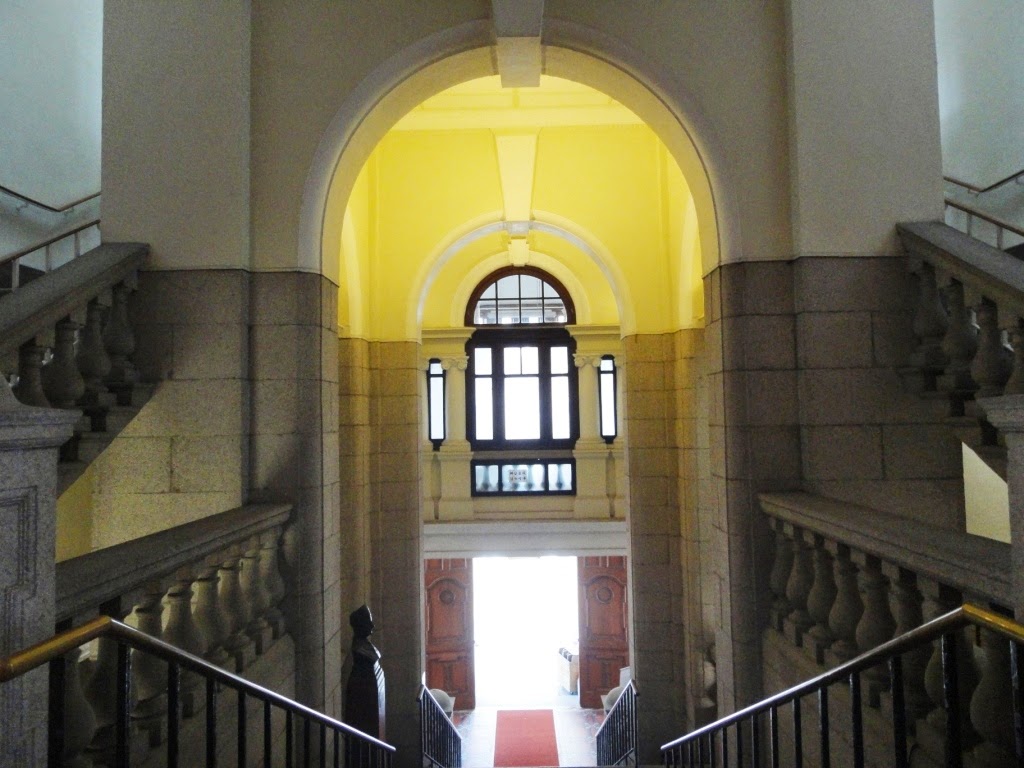
view near the library: the main building which I mistook for a church

inside the Main Building

post renaissance style facade


Saturday, August 16, 2014

Botero Abu Ghraib

112 pages with 86 color illustrations, published by Prestel (date published not indicated)
essay by David Ebony

Colombian artist Fernando Botero's works first caught my eye when, as a college student, I frequented forums on literature and history. What made his works appealing is his portrayal of men and women as curvaceous, a signature style that is now known as Boterismo. His style reminds me a lot of the Venus figurines, works of art showing round breasts and round bellies. Sure renaissance and baroque art were also replete with plump subjects whose nakedness display curves, but Botero's is much exaggerated because the subjects are rounder in shape and well, just voluminous, in vibrant colors. Definitely eye-catching!

So one day in 2012 while inside Booksale, I happened to see a book about Botero's works portraying the torture of Iraqi prisoners in Abu Ghraib prison when the US invaded Iraq under the pretext of liberating the country from Saddam Hussein's hands. I was hesitant to buy the book because one, the book is expensive at P320 (by a cheapskate's standards), two, I am already having storage problems, and three, anytime I need artistic inspiration I can just search the net anyway. In the end, Ebony's essay won me over since it gives a clear understanding of what Botero's works are all about, as a whole and more so, about the horrors of Abu Ghraib.

In his Abu Ghraib art series, Botero's sketches and paintings depict naked men in cells, blindfolded, in sexual acts with other men, in female underwear, and combinations of these. An insight into this portrayal, Ebony writes:
"Exploiting Islam's ban on homosexual acts, and the perception that for Iraqi men it is humiliating to be naked in front of other men, the soldiers threatened the nude male detainees with rape and forced them to simulate sex acts with each other." (p.9)

Also disturbing are the images of dogs attacking the prisoners. Straightforward and direct to the point, Botero's art certainly is clearly a statement against US policies, a protest against violence, and a "call for humanity in the face of man's inhumanity to man" (as Ebony aptly penned it).

In an interview with the Associated Press, Botero said he was "shocked by the barbarity, especially because the United States is supposed to be this model of compassion" (in Ebony, p. 13).
_______________________
When art goes beyond aesthetics to tackle social problems we face today, it becomes even more relevant as it gives voice to the oppressed, making the world know of their sufferings in the hope that we, as human beings, denounce all forms of violence.

Due to the graphic nature of his works, I am not inserting any image from the Abu Ghraib series in this post.

Saturday, May 24, 2014

Bohol 03012014 Day 4

Our last day in Bohol started with cheap breakfast at a carinderia in Panglao, near where Ging Ging's Hotel. Because I wasn't that hungry that early, I only had an order of ampalaya, half cup of rice, egg, and free soup, which cost me only P29. Maybe my subconsciousness was telling me I was spending far too much with last night's expensive dinner at Bohol Bee Farm.


We hired a habal-habal for half a day, stopping by the wonderful Hinagdanan Cave first. Entrance fee is P25 per person. Staff also charges P5 for parking. It was a pretty small limestone cave, but a beautiful one at that. I especially love how sunlight comes filtering through the cracks, illuminating the cave and making it look rather divine. And the cool still waters provided us much respite from the heat outside. I dipped in the pool for quite a while just to experience the fresh waters.


cave paintings of snakes with human heads
Now what fascinates me the most about Hinagdanan Cave is the paintings of snakes on the walls! It's my first time to see rock art. (I live in Metro Manila but I have yet to see the Angono Petroglyphs.) From the look of it, the painting doesn't seem to be that old. Still, the subject is quite interesting. Why paint snakes? I wonder what the artist had in mind when he made this? They remind me of nagas.

Next we went to Dimaluan beach, which is more beautiful and more peaceful than boat-filled Alona Beach. The next time I'm visiting Bohol, I'll make sure to spend a night in this area. Entrance fee is P50 per person, plus P25 parking fee. Here I spied a French scuba diver whom I approached and conversed with. I just love the surprised look on a Westerner's face when they find an East Asian looking girl speaking French. LOL. I just wanted to practice my French since it's been a long time since I last used it. Anyway, while my buddy was enjoying the waters, I found refuge under a big tree and read a book. My idea of beach bumming doesn't involve getting burnt.

under this tree I sat and read... and napped
 We headed back to our hotel before noon. As we were waiting for a jeep back to Tagbilaran, a taxi stopped by in front of us and asked to drop us off in the city for just a minimal fee. We grabbed the opportunity since it was very hot and the jeep was taking so long to arrive.

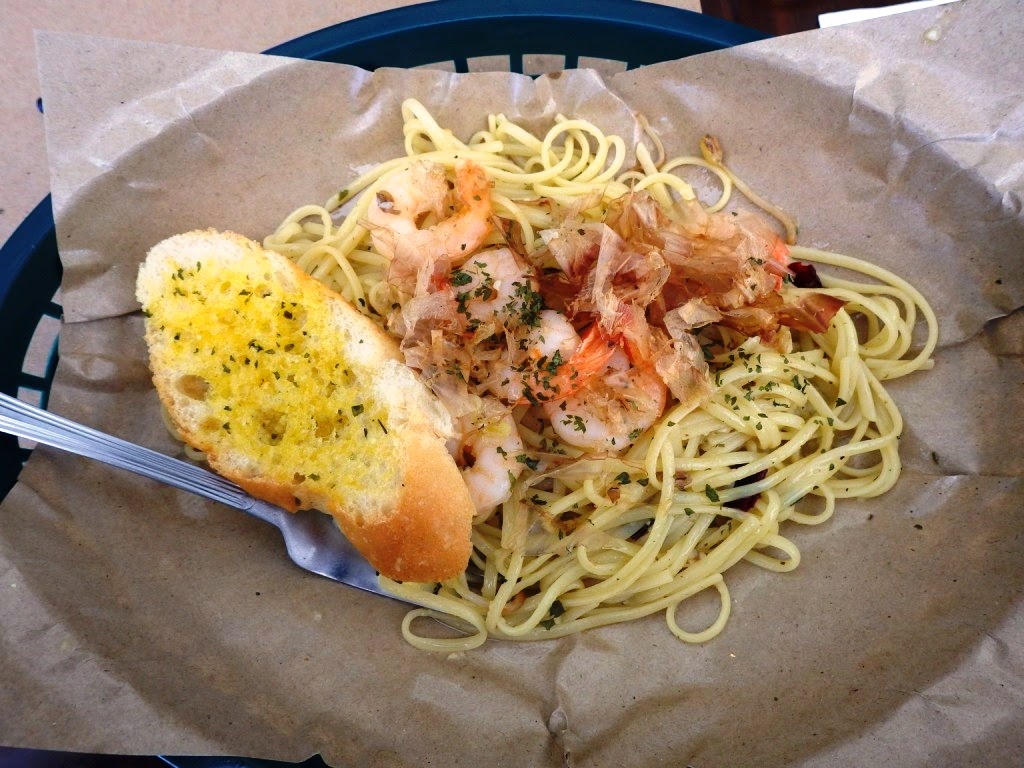
In Tagbilaran, we had lunch at Dong Juan. My buddy had a burger while I feasted on their gambas con ajillo pasta (P179). Yummy! We did some last-minute shopping at BQ Mall before we hit the airport to go back to chaotic Manila.

already missing this pasta. YUMYUMYUM!

Bohol Day 1
Bohol Day 2
Bohol Day 3

Monday, March 24, 2014

Siem Reap, Cambodia 0112172014

We arrived at Siem Reap around 5AM, still sleepy despite the comfortable bus ride we had with Giant Ibis. We went straight to Hak's House where we had booked 5 nights. The hotel was small and there were mosquitoes about due to the place's proximity to an almost dried up canal, but we had a pleasant stay there. The owner Hak was accommodating and very approachable. Did I say that I love their version of French bread with tomatoes and cheese? And to think I'm not even a sandwich person.

That same day, we headed to Apsara Angkor Hotel to register. There were already a lot of people. Due to lack of sleep, I dozed off a number of times during the plenary, which was sad because the speakers talked of the development of Cambodian archaeology. From the explorations by Westerners (French mostly) to the abrupt halt in archaeological endeavors in the Pol Pot regime, to the revisions in curriculum in archaeology, the plenary session was very informative for me since I don't remember including Cambodian archaeology in our class discussions.


The next four days saw us attending different sessions based on our research interests. There are of course boring lectures but I was lucky to have attended really really interesting lectures on archaeometry and cultural heritage management. I especially loved the presentations by Japanese and Chinese scholars and I realized that their contributions in archaeology are largely overshadowed by Western achievements primarily because of language barriers. Most of the presenters couldn't speak English very well, but looking at the flow of their research methodology, one can say that they are at par, if not better than most Westerners.

I was also fortunate to have conversed with some Chinese professors. When I asked them if they were going to present a paper, they said yes and invited me to their session. I was elated to hear that their session focused on scientific analyses of artifacts, something I have taken a liking to. The use of the latest technology to analyze artifacts is just appealing to me who loves doing lab work so much. (At that point, I wondered again why I didn't pursue a science course... Sigh! I could have dabbled in many experiments!)

Wednesday was reserved for a whole day tour in the Angkor Wat Complex. The intricately detailed carvings are just super awesome that they left me speechless.Many questions formed in my mind, like how many people built the magnificent structures, how they knew which material to use, which technology was available at that time, what led the rulers to commission the construction of such a massive temple complex. I also wonder how the laborers fared in the whole project. Were they slaves subjected to cruel whips or were they highly skilled craftsmen who join together under a ruler, or a mixture of both?


It was in Angkor Wat where a friend and I met a Chinese American girl who was travelling Mainland Southeast Asia all alone. We chatted a bit and afterwards, decided to meet up for dinner somewhere in Pub Street. We had a five-meat dinner composed of chicken, pork, beef, squid, and crocodile. I didn't know they also eat crocodile meat here. The first time I heard of crocodile meat was last year when I went to Palawan, and boy do I love the sisig version!


The last day of the conference was for me the best. It was when I saw the presentations of Chinese scholars and they were really brilliant! While at the session, all I thought about was how to grab a scholarship and be under the tutelage of expert scientists in China.

The last day I also got to chat with an Australian professor who remembered me. She was ever a lovely woman, very chatty and very nice. She lectured of geochemical characterization last year at ASP and she remembered me as the girl who "was good with computers" because I ran xPRF tests in rapid succession hoping to get the most of their visit because we don't have that ultra cool portable machine. She asked me if I also did GIS and I answered no. GIS is something I'd really love to learn given the opportunity to go back to school since I am fond of maps and mapping. Then again, it sucks not to have much funds for schooling. Tsk... SIGH!

Our last night in Siem Reap saw me and my friend having a relaxing time with fish spa (2 USD each). It was a bit surprising at first to feel the fish pecking at your feet but eventually it was fun and very relaxing.


I wish to go back to Siem Reap and explore more of their food. Also, we didn't get to explore other places due to lack of time. Of course we wanted to attend as many sessions as we could since we paid 75 USD for it. The price may be too high but it was all worth it. I was more than inspired.

On Friday night, we boarded the night bus to Ho Chih Minh.

Read about our Phnom Penh trip here.

Sunday, February 3, 2013

January 2013

And so it's February again, with lots of backlog carried over from last month. I've been planning a lot on how to accomplish tasks to no avail due to inevitable circumstances and surprise happenings that led to another failure in achieving my goals.

On the whole though, I'm pretty happy last month, having gone out with my tourmates thrice. I know that it may be because we just got back from a week-long trip and pretty much everybody misses everybody else and it may take a while before everything settles to being normal again. "Normal" meaning each going out with his or her usual group of friends prior to joining the tour. I have experienced this a lot and so I always remind myself never ever to get attached.

2013 has got many interesting movies to watch, some of which I have been anticipating since last year. I almost fell into a sad state when I wasn't able to watch The Hobbit: An Unexpected Journey last year and I am glad to have had watched it last month, with my tourmates. The venue was SM NE Imax Theater and I am not even a fan of SM Cinemas but at that time, only SM was showing said movie. Two days before that, I watched Les Misérables with a close girl friend and her mom, also at SM The Block.

At UPFI I watched Nacidas para sufrir, a drama comedy about an old woman who was aunt to three nieces. To help her and keep her company, the three nieces hired Purita, a saintly woman. Purita and Aunt Flora then got married just so the latter can bequeath her properties to the former. Trouble ensues when Purita's family entered the scene, leaving Aunt Flora desolate and penniless.

Also, I watched Santa Santita, a 2004 film by Laurice Guillen at the UPFI on a date with myself. When my archaeo friends invited me to go out with them to watch Hansel and Gretel I couldn't resist and found myself admiring the graphics of this movie. I just love blood and gore. Visual feast for me!!!

And speaking of self-dating, I also watched Katy the Musical alone though before that, I was with college friends touring a Thai exchange student around Malate. Katy is one energetic musical. I so love the singing and the dancing. And Isay Alvarez will become one of my fave actresses now, with her ultra commendable portrayal of vaudeville queen Katy dela Cruz. Also, I am surprised at Tirso Cruz and Epy Quizon's performance. I never thought they could do this well in theater! When I told my parents about how awed I was at Tirso Cruz's singing, they told me that he was not paired with Nora Aunor for nothing! I was like, WOW! (I'm not a Nora Aunor fan though.)

closing of Katy the Musical at CCP Little Theater
One thing I liked about January is that my sisters and I got to have our sisterly date again. We had dinner at Thai Manila along Tomas Morato. Since it was the first time we had Thai food, we were all overwhelmed by the strong flavors. Still, I think I'll love Thai food since I love spices. I hate ginger though.

Spring rolls, beef with veggies, and fried rice at Thai Manila- Tomas Morato
I also got to try out new restaurants thanks mainly to family dinner, and spontaneous invitations from college friends. Maybe it's the Heavens' way of making me busy, to distract myself from that boy who's in my mind a lot these days.

Glass ceiling of King's Chef- Lucky Chinatown
In addition, I think I am starting to run again. I'm not challenged much with brisk walking, it being part of my everyday routine already. I'm planning to put on my running shoes and experience the joy of moving the air and letting the wind blow through my hair. Running makes me feel alive. It makes me feel free. It makes me feel invulnerable.

I also started to draw again. One sleepless night I picked up the pencil and drawing book given to me by an officemate last Christmas. I picked out my Groove Adventure Rave manga and drew Elle, a dancing Elle with a look of happiness on her face.

And to end January, lines from X-Japan's "Endless Rain" keep playing inside my head:

"It's a dream, I'm in love with you (...)

The dream is over
聲にならない 
言葉を繰り返しても高すぎる 
灰色の壁は過ぎ去った日の思い出を 
夢に写すUntil I can forget your love"

Because I have grown used to him and yet I was left hanging... I should have known better.

Friday, November 30, 2012

From Multiply 093: Images of the Revolution in Spanish Painting Aug. '09


Last August 10, we the students of EL197 class, attended Prof. Maria Victoria Herrera’s lecture “Images of the Revolution in Spanish Painting” at CM Recto in the Faculty Center. While I must say that her presentation is quite boring on most parts, with her just reading her paper the entire time, I did appreciate the things I learned from here.

In connection to the Spanish Civil War, she presented the famous work by Pablo Picasso, the Guernica. But before she talked about Picasso, she first presented another famous Spanish painter, Francisco de Goya.

Francisco de Goya was one of those afrancesados, those who embraced not only the French liberalism, but also its culture and manners, thus they were shunned by the traditional society which believed in being nationalistic, closing their doors to foreign influences. He served in the French courts as royal painter and went back to his motherland where he received a cold shoulder. Nevertheless, he was able to produce great masterpieces, one of which is “El tres de mayo” where he immortalized in the four corners of his canvas the shooting down of the Spanish resistance against the Napoleonic invasion of Spain in the 19th century.

In this particular painting, we see one use of art, and that is the portrayal of a historical event. Sure accounts are quite abundant in the pages of history books but art, as in the case of paintings like “El tres de mayo” have a better way of capturing the images of the past. We see here the shock and the fear in the eyes of men whose imminent death lies ahead as soldiers point their weapons at them.

In the 20th century, the main representative of Spanish art would have to be Picasso, whose famed cubism was present in one of the most widely praised paintings of all time. The Guernica is a work of art created as a reaction to the events that were happening in Spain at that time. A brief background on history was presented. Guernica was actually a small town in the Basque country which was bombed by Franco’s troops despite it being an area of civilians and non-fighting people. When it was bombed on a market day, it is said that Picasso got angry and used the event as his subject for the mural project he was working on.
Here, we see that art has taken on the form of a reaction to what is happening around, reflecting the social conditions with which the painter lived. Also, it has evolved into something that promotes awareness, something like a propaganda that informs people about the present situation.

I’m afraid that I am most unworthy to comment on the paintings. While I admire Goya for his works “La maja desnuda” and “La maja vestida”, I can’t seem to appreciate the highly abstract works of Picasso, including the Guernica of course. Or maybe it’s just a matter of tastes since I am quite attracted to baroque paintings like those done by Titian, Lorrain, Vernet, and of course Peter Paul Rubens with all their mythological and religious subjects. I thought I couldn’t quite participate in the discussion which followed the presentation but I was wrong.

Bringing up something connected to religion is certainly an aperture for me. When someone asked about the dove as a sign of peace, I suddenly fell into thinking as to why use a dove with a twig on its beak as a symbol for peace? Prof. Herrera was not able to answer my question regarding this as I have said that the dove is a symbol of hope, as one can see in the story of Noah in the Book of Genesis. Upon seeing the dove come back with a twig on its beak, the family of Noah rejoiced, knowing that dry land had been found. Furthermore, I know that the dove also symbolizes the Holy Spirit though I don’t know where such symbolization originated from. There’s this Bible verse, too, that says that when one is filled with the Holy Spirit, he shall be filled with peace. A classmate of mine offered a brief answer saying that somewhere in the Bible, it is stated that the dove is a symbol of peace. And indeed I checked the New Testament for proof and voila, I found it in the first four books of the New Testament. When Jesus was baptized, the heavens opened and a voice was heard saying “This is my son for whom I am well pleased.” The disciples saw the Holy Spirit which descended like a dove. So I guess, this must be it.

Aug 26, '10 10:42 AM
for Miracle's friends, Miracle's family and Miracle's online buddies

Friday, October 26, 2012

07282012: 300 Years of Philippine Maps @ Metropolitan Museum of Manila


Last July 28 (Saturday), despite the rains and fears of being stranded due to flooding in one of Manila's flood prone areas, my friend and I attended the lecture by Dr. Benito Legarda Jr. on the life of Fr. Pedro Murillo Velarde at the Metropolitan Museum of Manila in Bangko Sentral ng Pilipinas Complex, Roxas Boulevard. Dr. Legarda also talked about the Filipino engraver Nicolas de la Cruz Bagay, among other things like the problems encountered in map-creation during those times, and also the differences between the 1734 and 1744 maps of the Philippines.

We were surprised to find out that Dr Legarda's talk was supposed to be held a week before our visit but due to bad weather, it was moved to July 28. In the afternoon, Florentina Colayco of UP College of Fine Arts talked about the artistic aspect involved in mapmaking, thus shifting the discourse from the scientific to the artistic. She gave examples of artworks associated with spatial identities, dislocation, utopian visions, protest against war, technology, and uprisings.

After this, Metropolitan Museum Director Sandra Palomar Quan hosted the guided tour upstairs where different artworks were on display. I especially find the exhibit on bottles interesting. In it, the artist turned regular bottles of ketchup, cheese spreads, and the like into works of art. Also, a post with many signs ubiquitous in the cities of Metro Manila, while considered an eyesore, here triumphs in calling the attention of visitors. Chunks of painted cement, on the other hand, may cause eyebrows to raise and may make one question if it is art. It's always interesting to know how artists create their works and where they derive ideas, and when you do understand why something is made the way it is, you appreciate it better.

*******************************************************************************
This post would include my first photo for the mere reason that the museum acknowledged my help with the exhibit. I volunteered as translator of the texts accompanying the maps from English to Filipino.

Saturday, October 20, 2012

05312012: Intramuros and National Museum

Months have passed since that last day of May this year when I roamed the streets of Intramuros then suddenly, it rained cats and dogs. I was at that time near NCCA so I went inside seeking refuge from the sudden downpour and found myself admiring this:


At that time, they were also holding the exhibit "Sining sa Buhay ng Tao" (Art in Life), centered on National Artist for Music Felipe Padilla de Leon. Said exhibit was from May 28 to July 16 of this year. I didn't know that this man had so many works! He had works for orchestra, violin solos, chamber, hymns both religious and secular, piano, opera, voice, etc.! And he even composed children's songs! Very impressive indeed!


The rain hasn't stopped yet when I decided to proceed to Pamantasan ng Lungsod ng Maynila to submit an important document. When I exited the gate near it, I realized I am near the National Museum of the Philippines so I dropped by the awesome place. As usual, I enjoyed the bare halls and interior designs.


Thursday, June 21, 2012

Lani Maestro at the Met Museum

June 23, 2012 - 3:00pm


Venue: Tall Gallery IV

Lani Maestro (Canadian, b in Manila, Philippines, 1957)
Lani Maestro’s art works have consistently pursued links between the concerns of Minimalist art and philosophic traditions associated with silence, emptiness or absence. She received a BFA from the University of the Philippines College of Fine Arts in 1977 and pursued graduate studies in Fine Arts at the Nova Scotia College of Art and Design in Halifax, Canada in 1988.

Maestro’s recent exhibitions include site-specific projects in Canada; her rain at Centre A, Vancouver International Center for Contemporary Asian Art, Plug In ICA, Winnipeg, and The Forgetting of Air at the Darling Foundry in Montreal, Canada (2010-2011). Her work has been shown internationally and has been represented in the 9thSharjah Biennale (2009), Tempo au tempo at the MARCO, Vigo, Spain (2007) Shanghai Biennial in China (2000), 11th Biennale of Sydney, Australia (1998), 5th International Istanbul Biennial, Turkey (1997), Asia Pacific Triennial in Brisbane, Australia (1997) and Crossings at the National Gallery of Canada in Ottawa (1998).

Maestro’s expanded art practice also includes engagement in art publishing, teaching and running an exhibition space in Montreal. In 1990, she began a collaborative project with artist-writer Stephen Horne and together, they founded Harbour Magazine of Art and Everyday Life, a journal of artworks and writings by artists, critics and theorists. This project expanded intoGalerie Burning, an itinerant exhibition space in Montreal and later initiated Burning Editions, which continues to publish artist’s books. For ten years, she conducted graduate seminars in the MFA program at Concordia University in Montreal and taught studio courses at the Nova Scotia College of Art and Design in Halifax and The University of Lethbridge in Alberta, Canada.

Lani Maestro has been a recipient of numerous art awards including the CCP Thirteen Awards in 1977 and the SegundaBienaldela Habana Prize in Cuba in 1985. She lives and works in France and Canada.

This forum received support from the Embassy of France to the Philippines in cooperation with MO_Space.

For more details, please call the Marketing Department at 708-7829 / 0922.8769533. 


This is a repost from www.metmuseum.ph.

Tuesday, September 27, 2011

Willem Haenraets (1940- ?)

The heavens still shed tears and here I am surfing the net with the hope of finding something that would be of interest to me. Lately, I have been feeling a little hollow inside, with no Muse to inspire me.

Tonight while lurking in the forums, I chanced upon a painting by William Haenraets, an artist born in Rotterdam, Netherlands. I was instantly enamored of the soft pastels conjuring a dream-like apparition of a white horse alongside its mistress in white. The painting seemed to have captured in an instant the two crossing a shallow body of water.


Curious, I looked up the artist and found these two other paintings of his:


"Two Girlfriends II"

"Young Girl II"

These remind me of impressionist paintings of the 19th century, though of course, the theme here is obviously young girls.

Note: The images are not mine.